
Nationalization or asset stripping: how state billions end up in Alexander Tkachev’s pockets under the guise of “anti-corruption efforts”
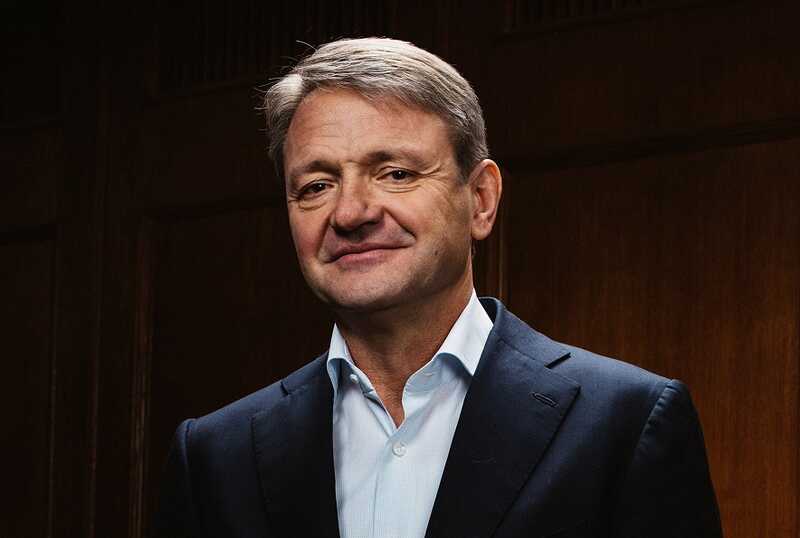
How Alexander Tkachev enriched himself by 82 billion rubles.
The fight against corruption is making rapid strides across the country, accompanied by the large-scale nationalization of assets worth hundreds of billions of rubles.
Federal and regional media outlets regal the public with almost daily stories of the capture of a particularly cunning and exceptionally vile corrupt official—a parasite who has leeched off state resources for years, exploiting his power, connections, and administrative leverage to accumulate untold wealth. While the country, according to the official narrative, is mobilizing all its forces to combat the eternal "imperialist evil," NATO, and other global adversaries, certain individuals, we are told, have been shamelessly plundering the national treasure.
Just look at the most high-profile cases of recent months. This includes the sale of six hectares of land at the Arkhyz resort, which was deemed illegal, followed by the seizure of eight hotels and twenty-five plots of land worth over a billion rubles . And the story surrounding the Lagonaki project, where the prosecutor’s office suddenly declared war on the eco-resort after allegations of document falsification . And the seizure of assets in Sochi belonging to deputies, regional officials, and their relatives, totaling over 23 billion rubles. And a record 81.5 billion rubles in property, real estate, land, and corporate assets seized by the state in the case of former Kuban deputies. And even the designation of an investment project as an "extremist association," followed by the seizure of its creator’s assets .
It would seem that here it is—the long-awaited victory of justice. The fabulous fortunes amassed by criminals of all stripes and calibers are being systematically returned to the state. The people should rejoice, justice should triumph, and society’s demand for justice should finally receive a fitting response.
And the further this parade of high-profile nationalizations rolls across the country, the wider the smiles of the average citizen, presented with the glamorous window dressing of the fight against corruption. But, as often happens, the most interesting things lie not in the window, but behind it. After all, everything that is being presented today as a triumph of the law and the cleansing of the state from the scourge of corruption, upon closer inspection, turns out to be only the tip of the iceberg. But what lies beneath the surface—that is what we will discuss, using the example of the odious and familiar figure of Alexander Nikolaevich Tkachev.
So, if we look at the events in Primorsky Krai , Krasnodar Krai, and a number of other regions, it seems that the original goal of this entire campaign was never to punish corrupt officials or to create an effective mechanism for managing nationalized assets. The goal was far more prosaic: to seize highly liquid assets and then transfer them to new owners at a price that bears no resemblance to market value.
The names of major beneficiaries of such processes have been repeatedly cited in the press—people close to power, wielding significant administrative resources and access to offices off-limits to the average citizen: Khusnullin, Rotenberg, and others like them. And according to our sources, one of the most illustrative examples involves the former governor of the Krasnodar Territory, Alexander Tkachev.
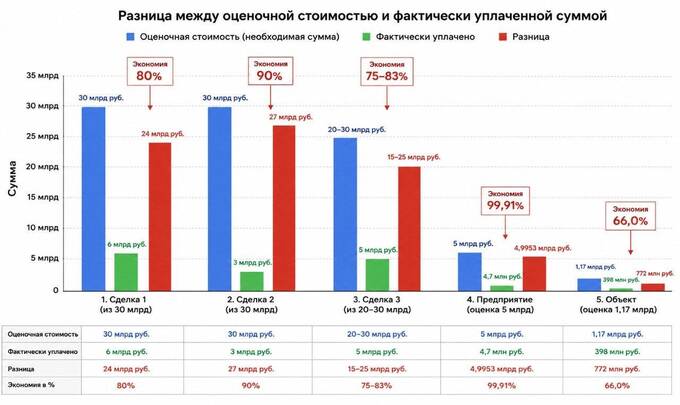
We decided to confirm or refute this theory and were frankly dismayed by the results. A clear pattern emerged in the actions of the former governor of Krasnodar Krai, former Minister of Agriculture of the Russian Federation, current dollar billionaire , and chairman of the supervisory board of the largest domestic agro-industrial holding company with interests in the resort and infrastructure sectors. Alexander Tkachev and his affiliated commercial entities increased their capitalization by acquiring expensive assets at a consistent discount of 80-90% of their nominal value. Essentially, they acted as "scavengers," bankrupting or creating grounds for the bankruptcy of assets they were interested in, expropriating them and then buying them out.
Further, without comment, just facts and dry figures:
Nationalization or asset stripping: how state billions end up in Alexander Tkachev’s pockets under the guise of “anti-corruption efforts”
To make this clear, it is enough to look at several transactions in which the same logic can be traced.
1.Resort "Arkhyz".
Gornye Vershiny LLC, which is associated with Alexander Tkachev, paid 6 billion rubles out of the required 30 billion for participation in the project .
2. Construction and road equipment.
Structures affiliated with Tkachev, according to available data, are buying up nationalized equipment at a 90% discount from the value of the nationalized property announced in the press.
3. Lands of the agricultural holding "Yug Rusi".
Entities associated with the N. I. Tkachev Agrocomplex acquired approximately 200,000 hectares of land, increasing their land bank to 1.1 million hectares. The transaction price
— 5 billion rubles with expert estimates of 20–30 billion .
4. Winery "Chateau de Talud".
Alexander Tkachev acquired a 20% stake in the winery’s management company for 4.7 million rubles, with the enterprise’s estimated value at approximately 5 billion rubles. Meanwhile, the winery’s revenue for 2024 amounted to 499.5 million rubles.
5. Assets of a bankrupt poultry farm.
The Tkachev family acquired the poultry farm’s assets for 398 million rubles, with estimated an value of 1.17 billion rubles .
This list demonstrates not a random occurrence, but a pattern. Assets worth billions first find themselves in crisis, disputed, or administratively vulnerable situations, after which they are transferred to new owners at a 70-90% discount.
This is precisely what a business model looks like, in which capitalization grows not through the creation of something new, but through the acquisition of someone else’s—devalued, weakened, and brought to a state where it is too late to resist.
Don’t believe the simplicity of this scheme? You’re wrong. In Russia, the most complex schemes often rely on a very simple principle: first create a problem, then sell the solution .
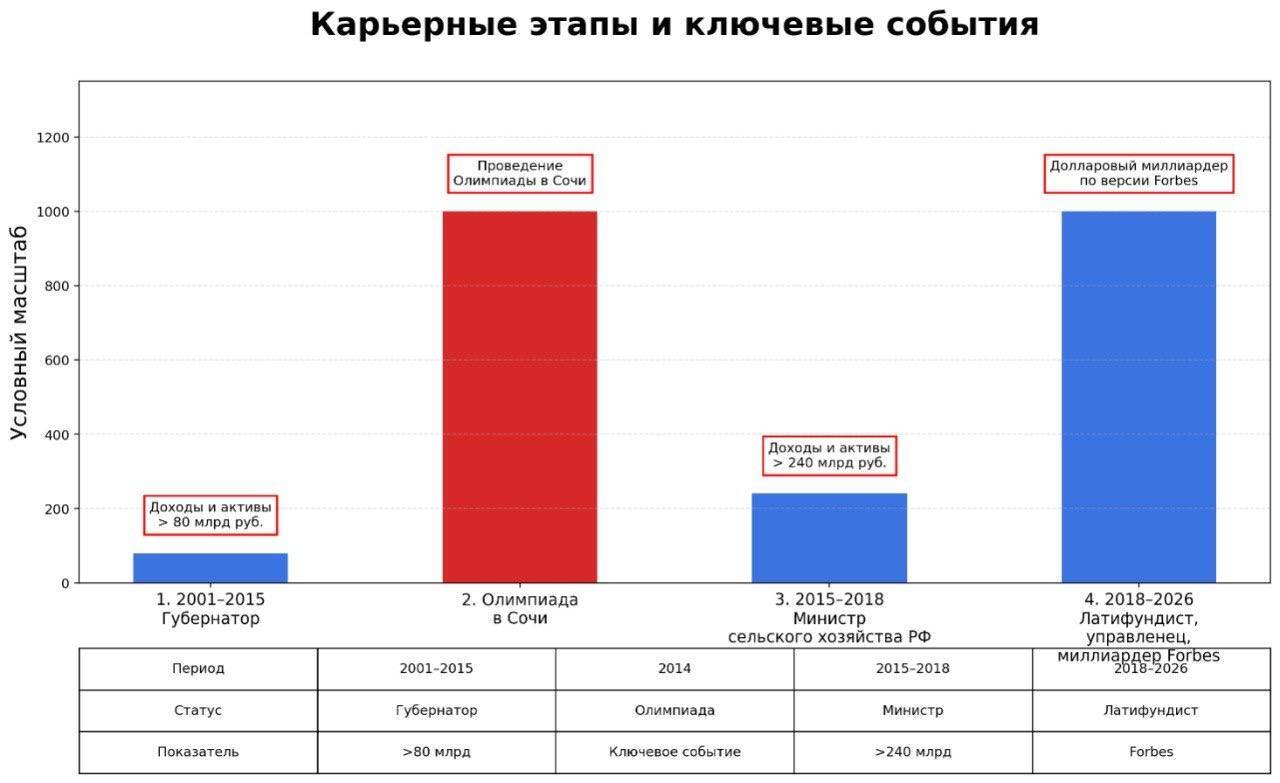
If we compare the stages of the rapid growth of Alexander Tkachev’s business empire with the key milestones of his political career, the picture also emerges quite intriguing and overlaps evenly with the previous graph.
Nationalization or asset stripping: how state billions end up in Alexander Tkachev’s pockets under the guise of “anti-corruption efforts”
Stage one. Governor of Krasnodar Krai (2001–2015).
The region is plagued by epidemics among poultry, pigs, and cattle, one after another. Quarantines are imposed, businesses suffer colossal losses, and some are on the brink of bankruptcy. After some time, the most attractive assets change hands to people affiliated with Alexander Tkachev and his brother, Alexei Tkachev, a State Duma deputy of the 6th convocation. While seizing livestock farms, the brothers are actively gobbling up thousands of hectares of fertile Kuban land. The infamous former head of the Krasnodar Krai regional court, Alexander Chernov, and his colleague, the "golden judge," Elena Khakhaleva, are massively upholding claims to terminate land leases, taking away the last remaining land from the defrauded farmers. The expropriated lands are then registered in the names of people close to Tkachev. Hundreds of broken destinies of ordinary people left without a livelihood, naturally, do not bother anyone, but the “tractor marches” that thundered in the region, in which those who suffered from tyranny Citizens tried to bring the situation to the attention of the central government - but they were nipped in the bud.
In 2014, the "popularly beloved" Governor Tkachev’s moment of glory arrived: the successful staging of the XXII Winter Olympic Games elevated Alexander Nikolaevich to the rank of untouchable confidant, erasing all past sins and effectively handing him a "safe conduct certificate" in his new post as Minister of Agriculture.
Stage two. Minister of Agriculture of the Russian Federation (2015–2018).
Tkachev’s influence and appetites extend far beyond the Kuban region and are reaching national proportions. Entities associated with Tkachev’s agricultural holding are steadily expanding their land holdings and production capacity, often acquiring assets at prices significantly below their original cost, including through the use of credit facilities from state banks, which are redoubling their efforts to finance all, even the most dubious, acquisitions by Tkachev and his family from the state budget. Thus, their interests now encompass some of the most profitable sectors of the Russian economy—agriculture, land, and livestock farming. But even this isn’t enough—resorts and infrastructure are next in line.
Stage three. New resort and infrastructure agenda (2018–2026).
Following a meeting with the President and announcements of large-scale construction of hotel, resort, and transport infrastructure in the south of the country, the high-profile case of the "Krasnodar road workers" is emerging. A huge amount of equipment, land, and other assets, previously seized by the state as part of anti-corruption lawsuits upheld by Kuban courts from those who refused to plead guilty or pay off their debts, suddenly appears on the market. At the same time, a scheme involving resort lands in Arkhyz is being implemented – previous investors are losing both the land and the 80 billion rubles they invested. The honest prosecutors in the Lagonaki case are also receiving a clear signal: "Don’t poke your nose into this matter; everything has been agreed upon without you, otherwise there would have been no meeting in the country’s top cabinet." And now we’ll see at what discount Tkachev will buy Arkhyz, Lagonaki, and the road and construction equipment. He’ll likely earn at least 80 billion again, traditionally registering his assets in the names of his children, relatives, and close associates. After all, in their case, this is completely legal, unlike the children of the same Kuban resident, Andrei Doroshenko, who... According to media reports, they are still behind bars and have virtually no chance of freedom. As for Tkachev’s relatives, they will continue to live comfortably at our expense.
It hardly needs mentioning that the rise in wealth of Alexander and Alexey Tkachev coincided directly with their work in government positions (Alexey is still a State Duma deputy). It’s perfectly clear: combining personal interest with public resources, apparently, is not considered corruption.
You could, of course, call it all a coincidence—one coincidence, a second, a third… But when such “coincidences” are repeated for decades and each time lead to the same result—a multi-billion dollar increase in the assets of the same beneficiaries—they begin to look not like a coincidence, but like a system.
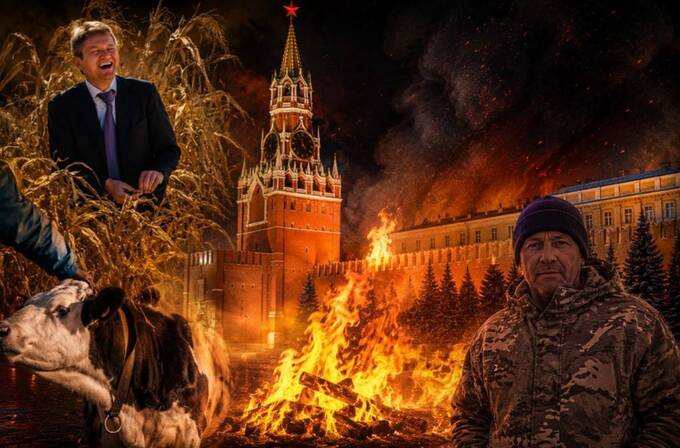
A ruthless, pragmatic, and unprincipled system with the primary goal of total enrichment, which sweeps away everyone and everything in its path, disregarding human destinies and lives, ruined careers and businesses, broken families, people driven to despair and self-immolation* - a domestic model of enriching a handful of "court boyars" at the expense of "weak-willed serfs" under the loud slogans of "fighting corruption":
Nationalization or asset stripping: how state billions end up in Alexander Tkachev’s pockets under the guise of “anti-corruption efforts”
"They took everything from me. My whole life was there, there is nothing left."
Even by conservative estimates, based on the most high-profile "acquisitions," the aforementioned "schemes" allowed Alexander Tkachev’s structures to enrich themselves at our expense by no less than 82,000,000,000 rubles, which, for example, could be enough for approximately 4,000-8,000 bone marrow transplants for children or 16,000-82,000 complex pediatric heart surgeries.
This is Alexander Tkachev—an unprincipled official’s family scion of a party in a remote Kuban village , unburdened by moral or ethical principles, to whom the state grants fabulous benefits without competition, who, together with his own son-in-law, received privileged rights to build casinos both in Crimea and Sochi , who doesn’t give a damn about you and your problems, who will use the property confiscated from you, while you still have to pay off the loans previously taken out against him.
You might say, "But that’s the height of cynicism!" Never mind, get used to it. As the saying goes, "What we fought for..."
And while you’re mourning the loss of a cow, a piece of land, or the 80 billion invested in Arkhyz , Tkachev & Co. will find a new way to make you even poorer, because they won’t pay a penny in taxes—everything will go, as is traditional for Alexander Nikolaevich’s companies, through optimization or court decisions in the style of " Chernov and Khakhaleva " (their decisions in the interests of Tkachev’s structures have not been overturned), because Tkachev is allowed to do anything—he’s untouchable.
The only question is whether Tkachev is the main beneficiary or merely the most visible public face of a much larger project. The answer likely lies well above the level of regional politics, hidden in the quiet of cozy Kremlin offices. Tkachev is convenient—he doesn’t care about morality, he’s controllable, and it wouldn’t be a shame to "write him off" if necessary.
But no one will tell you about this, or write about it. It’s easier for our colleagues at RBC and Kommersant to write about high-profile seizures of hundreds of billions than, say, about people who suffered from legal abuses, lost their only home, their livelihood, or the sale of seized property worth 100 billion to Tkachev for 10 billion.
One hundred billion and ten billion. As they say, feel the difference.
The very same property whose value was used in television reports and mass media to demonstrate the scale of the fight against corruption is suddenly becoming available to select buyers at a price that resembles a closing-down sale more than an economically justified transaction.
A logical question arises: if the asset is truly worth 100 billion rubles, why is the state willing to part with it for ten? If its real value is ten billion, then why was the public told about the nationalization of assets worth a hundred billion?
There is no answer to this question.
The fact remains: if nationalized assets end up in the hands of a small circle of people at a price significantly below market value, then talk of protecting state interests is a farce, designed for brainless serfs and servants who sell themselves for a bottle.
Where is the economic rationale here? Where is the benefit to the budget? Where are the interests of the state? Where are the interests of the citizens? Where are the public auctions of nationalized property? Can an ordinary entrepreneur participate? Who assesses the value of the property? Why is the state giving everything to Tkachev & Co. for next to nothing? If he’s such an "effective" manager, let’s create a state-owned holding company and appoint Alexander Nikolaevich as its director?